
Ultimate Guide to the 5 Love Languages Quiz Experience
Take 5 Love Languages Test
Get StartedWhat This Quiz Is and Why It Matters
Understanding how you and the people you care about give and receive affection can transform relationships from guesswork into clarity. The five-style framework distills core preferences into practical categories, helping you notice what actually lands and what gets lost in translation. Rather than relying on assumptions, you can use structured reflection to surface patterns, reduce friction, and build intentional habits that show care in ways that resonate deeply. This approach becomes a shared language, which is why it has endured across cultures, ages, and relationship types.
Many readers start by exploring easy self-assessments that translate abstract feelings into clear signals you can act on daily. For a quick orientation to your preferences, you could try the classic quiz 5 love languages version to benchmark your tendencies before deeper exploration. Origin stories also matter when you want to trust a framework and understand its scope and intent without diving into jargon. For historical context, lots of people reference the foundational 5 love languages by Gary Chapman quiz as a touchpoint that shaped the modern conversation about affection styles across different life stages.
- It replaces guesswork with structured self-knowledge.
- It turns goodwill into targeted actions that feel meaningful.
- It creates a shared vocabulary that reduces misunderstandings.
- It scales from personal reflection to team dynamics and family life.
How the Quiz Works and How to Read Your Profile
The assessment typically presents paired choices, scenario prompts, or quick preferences that compare which form of care feels more impactful in a given moment. Across many items, a pattern emerges, highlighting a primary style, a strong secondary, and supportive tendencies that still matter in day-to-day life. Rather than treating results as a rigid label, you can see them as a snapshot of your current needs, influenced by context, stress level, and life season. This is why revisiting your profile periodically can be enlightening, because shifts in priorities often surface before you consciously notice them.
When you finish a structured assessment, you’ll see relative scores that signal how much each category resonates with you in practical terms. To stress test your insights, you can start with a standardized 5 love languages quiz and test and then journal about real moments when care felt especially energizing. Because terms can blur together without examples, it helps to compare categories side by side for clear differentiation across daily behaviors. For a broader lens on phrasing, some people prefer a variant like the 5 love languages love language quiz to see if alternative wording shifts their responses or priorities in a meaningful way.
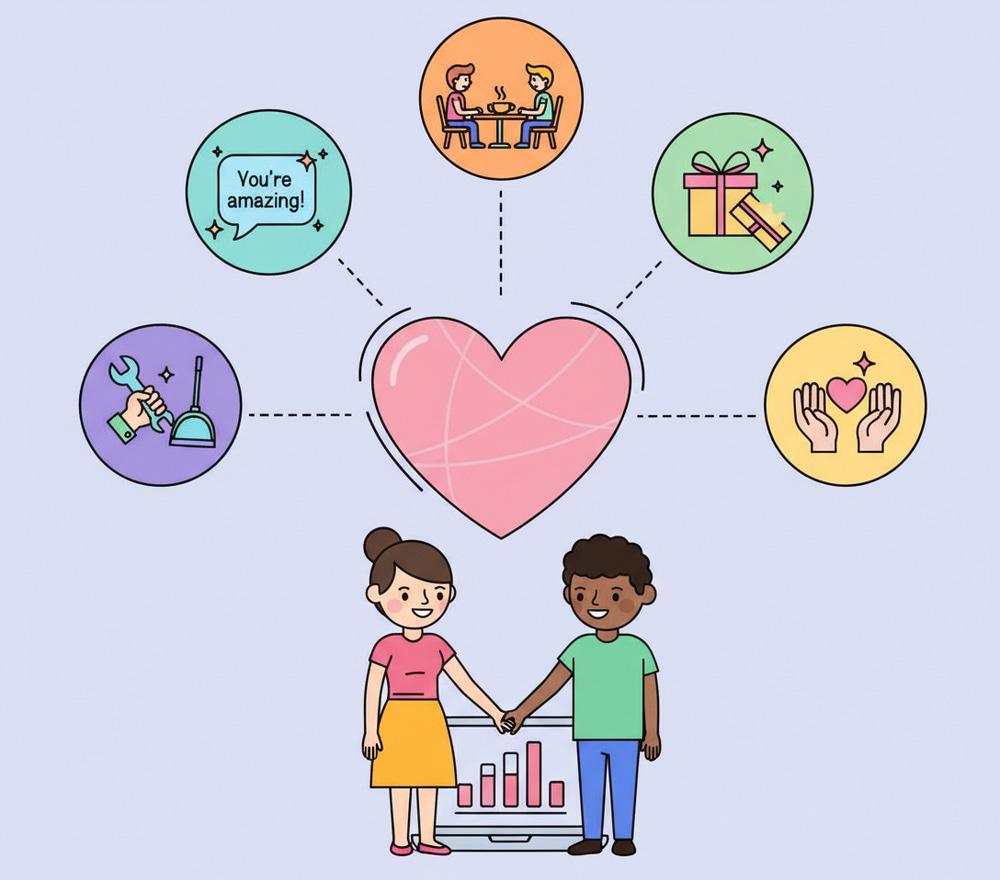
| Core Style | What It Often Looks Like | Useful Micro-Actions |
|---|---|---|
| Words of Affirmation | Sincere praise, encouragement, and thoughtful check-ins | Send a brief note, highlight effort, name specific strengths |
| Quality Time | Focused presence without distractions or multitasking | Plan device-free moments, share a walk, schedule mini-rituals |
| Acts of Service | Proactive help that reduces mental load or stress | Handle a chore, prep a meal, set up a system that saves time |
| Gifts | Thoughtful tokens that show attention and remembering | Small surprises, meaningful mementos, practical items they need |
| Physical Touch | Warm, respectful contact that signals safety and care | Hugs, a hand on the shoulder, playful high-fives with consent |
- Treat results as directional, not definitive.
- Validate insights with real-life experiments.
- Share your profile with trusted people for feedback.
- Revisit your profile when routines or stressors change.
Deepening Connection for Couples
Romantic partners often have compatible intentions but contrasting preferences, which can lead to accidental misfires. One person may plan elaborate dates seeking shared presence, while the other tirelessly completes errands that quietly keep life running, and both can feel unseen. The solution is not to abandon your natural style but to translate care into the form your partner experiences as most nourishing. When partners make that switch together, tension drops and affection feels efficient, natural, and deeply satisfying on ordinary days and milestone moments alike.
Relationship check-ins are a powerful complement to discovery exercises that clarify what lands and what does not. If you’re mapping patterns together, many partners enjoy the tailored 5 love languages quiz for couples because it contextualizes preferences within shared routines. You can then agree on small rituals that match each person’s top styles so goodwill no longer gets lost in translation after busy weeks. For a broader baseline you can also compare responses to a general-purpose 5 love language quiz and discuss any gaps between your instinctive answers and your partner’s lived experiences during a calm conversation.
- Translate thoughtfulness into the form that feels meaningful to your partner.
- Schedule micro-rituals that are easy to keep, even on hectic days.
- Use reflective questions to turn conflict into learning.
- Reaffirm what’s working so it becomes a maintained habit.
Using the Framework at Work and on Teams
Professional environments thrive on clarity, trust, and morale, yet recognition often defaults to one-size-fits-all gestures that don’t land evenly. People feel acknowledged in different ways, just as they do in personal life, so managers and peers can amplify motivation by aligning appreciation with preference. A brief assessment or guided conversation can surface whether a teammate values spoken praise, uninterrupted collaboration time, tangible support, thoughtful tokens, or appropriate, consent-based gestures such as a congratulatory fist-bump. When you calibrate how you say “thank you,” you build psychological safety and improve retention while encouraging a culture of practical empathy.
Some organizations start by mapping team tendencies and codifying appreciation norms that feel inclusive and easy to sustain in daily workflows. For leaders designing recognition rhythms, a tailored tool like a 5 love languages workplace quiz can illuminate how to celebrate wins without creating awkwardness. Small changes such as shout-outs during standups or scheduling focused pairing sessions can energize teams without cost or complexity. As policies evolve, managers sometimes pilot a focused resource similar to a 5 love languages at work quiz so that onboarding includes appreciation preferences alongside job expectations.
- Document appreciation preferences in team playbooks.
- Rotate recognition formats so everyone gets a turn to feel seen.
- Pair feedback with the right medium to boost receptivity.
- Model inclusive practices that respect boundaries and consent.
How to Take the Assessment and Act on Results
Start by choosing a clear, reputable questionnaire and set aside a few quiet minutes with your phone on silent. Answer quickly and honestly, choosing the option that feels most true in ordinary life rather than an idealized version of yourself. When you receive your profile, look for the top one or two categories and write down two specific, low-effort actions you can perform this week. Then share your insights with a trusted person so they can respond in kind and you can co-create supportive routines that require little willpower to maintain.
Explorers who want accessible options appreciate that many providers offer a zero-cost baseline to begin reflecting right away. If budget is top of mind, you might try a reputable 5 love languages quiz free to get a snapshot you can refine through conversation. After your first pass, add real-life validation by tracking a handful of moments that felt particularly encouraging or deflating. For a cost-conscious start with high usefulness, many readers prefer a free 5 love languages quiz as a springboard to deeper workbooks, journaling prompts, and relationship experiments that make insights stick.
- Write down two tiny, repeatable actions aligned to your top styles.
- Ask a loved one or teammate to share their preferences, too.
- Review what works after two weeks and refine the plan.
- Reassess during life changes like new jobs, moves, or parenthood.
Common Mistakes, Nuances, and Best Practices
It’s tempting to treat categories like fixed labels or use them as debating tools, but the real power lies in curiosity and adaptation. Profiles shift with context, and many people have blended priorities depending on stress, health, or season of life, which means rigidity backfires. Another pitfall is imagining grand gestures are required, when consistent micro-actions create the most trust over time. The healthiest pattern is a loop of observation, experiment, feedback, and iteration, so you can keep aligning thoughtful effort with what’s actually meaningful to the person in front of you.
Teams and families also benefit from explicit conversations about boundaries, since even kind intentions can misfire without consent and clarity. For workplace settings, some leaders use a structured lens akin to a 5 love languages work quiz to normalize talking about appreciation in a respectful, inclusive way. Across contexts, the aim is the same: make it easier for good intentions to cross the gap between people and arrive as care. When that happens reliably, relationships feel safer, collaboration gets easier, and everyday life carries a bit more warmth without requiring extra time or money.
- Use styles as a guide, not a weapon.
- Favor tiny, consistent actions over rare grand gestures.
- Revisit preferences periodically as life circumstances change.
- Make boundaries explicit and model consent-based behaviors.
FAQ: Quick Answers to Common Questions
How long does a typical assessment take?
Most take between five and fifteen minutes, depending on question count and whether you pause to reflect. Quick formats are great for a first pass, while longer versions can offer finer-grained distinctions that spark rich conversations about everyday habits and needs.
Can results change over time?
Yes, profiles can shift with new roles, stressors, and seasons of life, which is why revisiting the tool annually is helpful. You might also notice short-term swings during major transitions, so consider a lightweight check-in whenever routines change significantly.
Is this approach useful outside romance?
Absolutely, the same clarity that strengthens partnerships can sharpen parenting, friendships, and teamwork. By aligning appreciation with preference, you reduce misfires and build durable trust in any context where people collaborate or support each other.
What if my partner and I have very different top styles?
That’s common, and it’s manageable when you translate care into what the other person experiences as meaningful. Trade small, sustainable rituals that fit each style, then review together after a few weeks to reinforce what works and adjust what doesn’t without blame.
Where should a beginner start?
A sensible starting point is to choose a trustworthy resource and complete one concise assessment without overthinking your answers. From there, many beginners compare notes using a widely recognized 5 love languages quiz so everyone shares a common vocabulary while exploring next steps that feel authentic.